Addressing the gaps
After four years of attending U of T and being registered with Accessibility Services, it has become apparent to me ( based on personal experience and of others) that despite having an accessibility system designed to support students, it is clear that there is a gap between the provision of accommodations and the implementation of accommodations and other accessibility features within the classroom.
Simply put: there is a disconnect between the academic side and accessibility side of U of T, and students with disabilities are suffering in the process.
What made it clear to me that this was the case (despite having an overall positive experience with Accessibility Services) was a TA in the second year: For this particular political science course, we were expected to quizzes for the course as stated in the syllabus. However, it was not mentioned in the document which dates the tutorial quizzes would take place. Which was slightly concerning as it was a half course. Yet I did not worry too much about it, as sometimes they announce the dates later after the first two weeks of the course. After three weeks we had our first tutorial, which was mainly introductions. However, over the weekend, our TA announced our first quiz would be that Wednesday – within two days time.
Now despite the overwhelming fact I had two weeks to prepare for a quiz, the only reason why I was upset – on the verge of angry was the fact that I did not have enough time to register with Accommodating Testing Services. They require at LEAST two weeks before the day of the exam/quiz to get accommodations. Not two days.
I checked my accommodation letter ( a document that lists out my accommodations for my professors and TA) to see if it was mentioned anywhere, and much to my disappointment it was not.
I ended up writing a lengthy email to the TA explaining in detail the process students registered with accessibility services must do in order to get accommodated for tests, quizzes and exams. Much to the TA’s credit, he was horrified and would grant all students with accommodation letters an automatic two-week deferral to apply for all of the quizzes with ATS.
But why should it be the student having to self-advocate for this to happen?
Why are TAs and by extension professors who are unfamiliar with the processes students go through to get accommodations?
If only students, faculty and accessibility staff could be in one room and sort this issue – this gap – together.
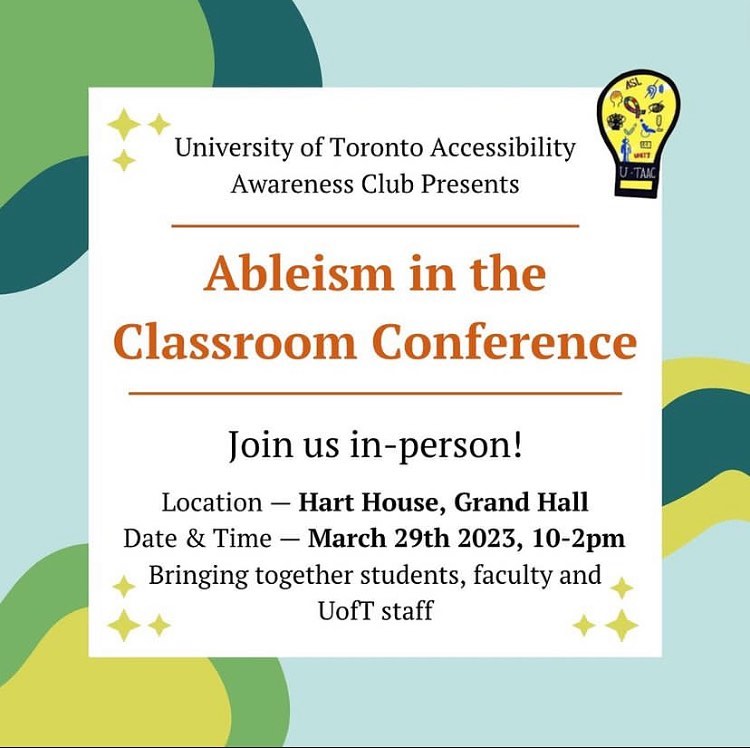
And just like that – the idea of Ableism in the Classroom was formed in my mind. It would wait until U-TAAC was formed in 2021 and it grew in stature in 2022 before any plans for a conference to take place.
That being said, the idea was cemented early on. All it required was organization, structure, finding speakers, sponsors, and volunteers for it to happen.
Planning with Purpose & Early Set Backs
Once a conference was confirmed in the early planning in the Summer, it was time to find a venue, speakers, and sponsors, and figure out the general structure of the event.
Figuring out programming was overall the easy part as we all knew that we wanted to have three panels for students, faculty and staff.
However finding a venue, speakers and sponsors were tricky.
Venue
U of T, despite its renewed commitments to accessibility and current construction/ renovation projects to make its spaces more accessible, there were not a lot of spaces that were accessible.
As an Innis Student, it would bring a lot of pride to host it at Innis Town Hall, yet it’s designed to be a lecture hall. Meaning there are a lot of stairs, and the chairs/desks don’t really accommodate for different body types or a person’s need to get up and move around. Not to mention those with mobility devices would be stuck at the bottom. Overall, I never found the space accessible, so it was immediately off the list.
Victoria College and Sidney Smith were also potential candidates but I found them to have the same problem as Innis Town Hall or they were too small and not suitable for a conference.
Which left Hart House. Hart House is not perfect, but it is wheelchair accessible, it has recently added an accessible bathroom in the basement, accessible study space – Arbor Room, added depth perception accessibility features on its basement stairs. It is also conveniently located at the heart of the campus.
They were also willing to make sure that the event was accessible which was a bonus.
Speakers
The process of finding speakers took about eight months in total.
The first was finding student speakers, which was done through a form that all members of U-TAAC and students registered with Accessibility Services were allowed to fill out to demonstrate their interest. Then after we had a number of candidates, we met with them individually and ask them potential questions to share their personal experiences. We did have to remove a speaker due to unforeseen logistical issues a day before the conference, unfortunately. This has taught me the importance that it is better to move on with the original plan instead of trying to shoehorn someone at the very last minute without proper planning or screening.
Professors were a bit tricky, as we couldn’t simply ask professors to fill out forms. Instead, the team decided to ask our own professors if they would like to be a speaker. The goal was, unlike the student speakers, to ensure there was diversity in the discipline. As accessibility practices differ if your professor is on the “art/humanities” side or the “science” side of the faculty of art and science. As most humanities students are most likely to deal with essays and tutorials than weekly quizzes and practicums.
The Accessibility Panel was overall the easiest as I knew the staff from Accessibility Services personally. However, we were unable to get a speaker from ATS. Which is not the same thing as Accessibility Services. I tried getting the Director of ATS, I even reached out to the staff over email and in person. But I was unable to get anyone who was available.
Originally, our keynote speaker was supposed to be David Onely, a political science professor from UTSC, the former lieutenant governor of Ontario. However, he, unfortunately, passed before the conference. Which forced the team to pivot and find a new keynote.
We also got a few opening speakers: Ben Poynton who is the AODA officer at U of T. Professor Brigid Burke who reflected on her experience as a former student and professor with a disability. Bill Ju, the Vice Dean of Art and Science.
Having individuals of a certain calibre such as the Director of Accessibility Services, U of T’s AODA officer and the Vice Dean of Art and Science was to ensure that all the important issues raised in the conference served a purpose: so that those in power would be able to implement these issues into practical next steps.
 Catherine CC Dumé
Leave a comment